Aircraft Branding: How to Turn Your Aircraft Into Your Best Marketing Asset
TL;DR — Aircraft branding is the design of everything on and in the aircraft itself: exterior livery and paint, tail treatment, registration presentation, interior finish, and the smaller surfaces most operators forget. Done right, the aircraft becomes your most photographed, most trusted marketing asset. Done wrong, it's a seven-figure mistake that flies for a decade.
What is aircraft branding?
Aircraft branding is the application of a brand identity to the aircraft itself — exterior livery, paint scheme, tail design, registration marks, interior materials, and every branded surface a passenger or ramp observer sees. It sits inside a full aviation brand system, but the aircraft is the highest-stakes canvas in it: the most expensive to apply, the longest-lived, and the most photographed.
For an airline, that means fleet livery. For a charter operator or a corporate flight department, it means something subtler but just as deliberate: a paint scheme, cabin, and detail language that signals exactly who you are before anyone speaks to you.
Three facts make the aircraft different from every other branded surface you own:
- It's permanent. A full repaint takes an aircraft out of revenue service for two to four weeks and stays on for seven to ten years. You don't iterate a livery; you commit to it.
- It's public. Your aircraft is photographed at every FBO, tracked on every spotting site, and seen from every terminal window. It markets you whether you planned for that or not.
- It's proof. In an industry where buyers read every signal for competence, the state of your aircraft is your credibility. A tired paint job on a charter jet says more than any website copy can undo.
What does aircraft branding actually include?
Most people picture a logo on a tail. The full surface list is longer, and the operators who look most polished are deliberate about all of it:
- Livery and paint scheme — the overall exterior design language: base color, accent flow, how the scheme moves across the fuselage curvature.
- Tail treatment — the most visible and most photographed surface on the aircraft. In airline branding the tail is the brand; in business aviation, restraint on the tail is often the statement.
- Registration and required marks — tail numbers and regulatory markings have mandated sizes and placements. Good design integrates them; bad design lets them fight the scheme.
- Winglets, cowlings, and stripes — the accent surfaces that make a scheme feel designed rather than defaulted.
- Entry experience — door surround, air-stair detailing, threshold plates, crew presentation. The three seconds of boarding set the brand impression for the whole flight.
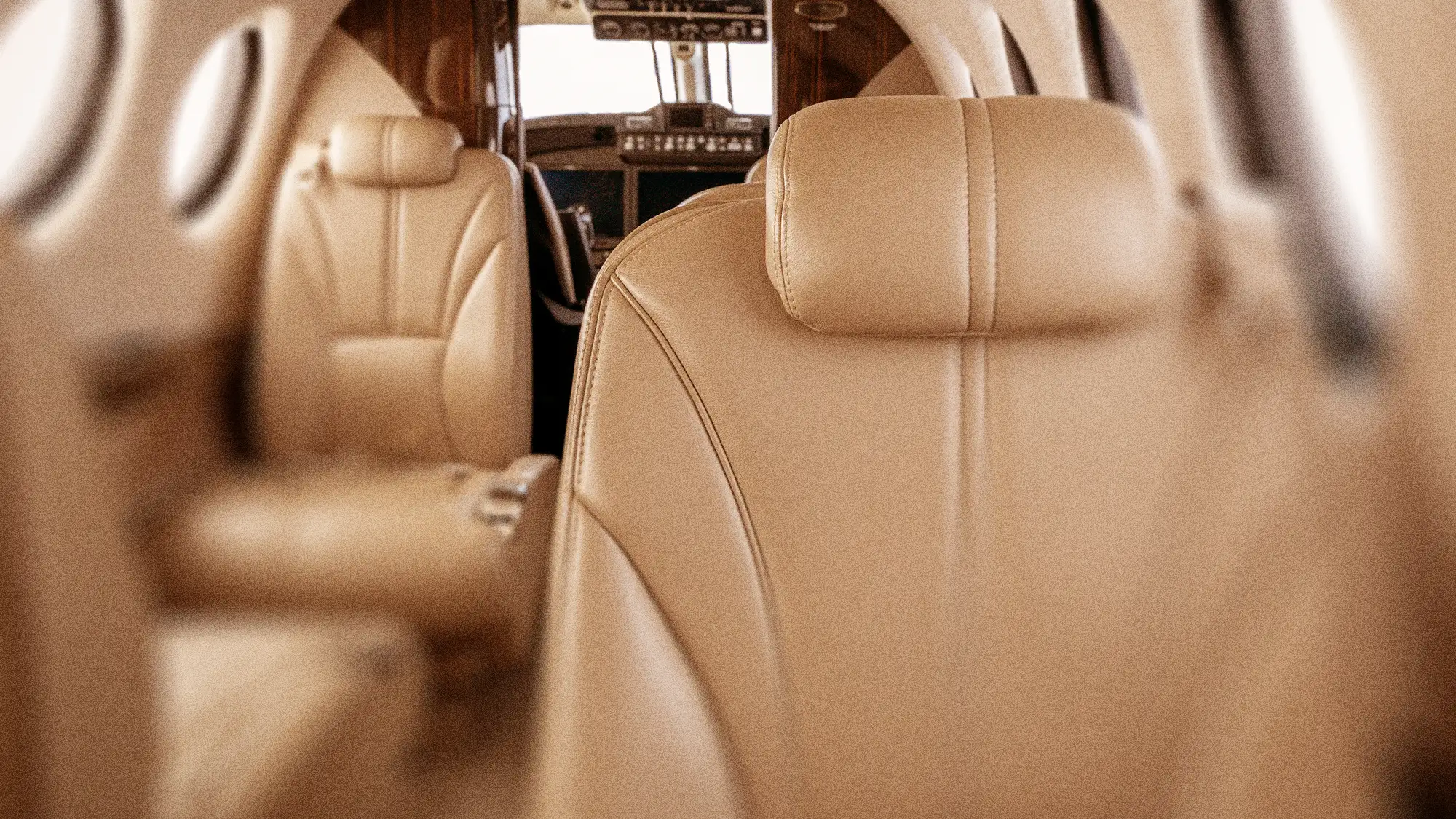
- Interior — seat materials, stitching, veneers, bulkhead branding, cabin plaques, headrest embroidery, amenity details. For charter, the cabin is where the client actually lives with your brand.
- The small print — safety cards, cabin signage, cups, napkins, Wi-Fi splash screen. Cheap to do well, loud when done badly.
Why does aircraft branding matter commercially?
Because in aviation, the aircraft is the product photo. Nobody charters a jet, enrolls in a flight school, or buys an aircraft without looking at the machine — and what they see gets read as evidence.
- For charter operators: clients and brokers judge fleet condition instantly. A crisp, consistent scheme across the fleet signals an operator who maintains what they own. Inconsistent liveries from piecemeal acquisitions signal the opposite, fairly or not.
- For brokers and sellers: presentation moves price. The same airframe photographs dramatically differently with fresh paint and a considered scheme — and listings are won and lost on photography.
- For corporate flight departments: the aircraft carries the company's identity into every airport it visits. Some companies want visibility; many want deliberate discretion. Both are branding decisions, not defaults.
- For airlines: the livery is the single largest brand-media purchase the company will ever make. A fleet of flying billboards, photographed millions of times, for the cost of paint.
The commercial logic mirrors everything else in aviation marketing: tiny audience, high stakes, trust decided on proof. The aircraft is the proof.
What does aircraft branding cost?
Ranges vary widely by aircraft size and scheme complexity, but the honest framing looks like this:
- Light jet / turboprop full repaint: roughly $50,000–$150,000 including design, strip, paint, and reassembly.
- Midsize to large-cabin business jet: $150,000–$500,000+ depending on scheme complexity and materials.
- Airline narrowbody: $150,000–$300,000 per aircraft in paint alone — which is why airlines sequence rebrands across the heavy-maintenance cycle rather than repainting on impulse.
- Downtime: two to four weeks out of service. For a revenue aircraft, downtime often costs more than paint.
- Design fees: a fraction of the application cost — and the only part of the budget that determines whether the expensive part was worth it.
The takeaway isn't "this is expensive." It's that the cost structure punishes bad decisions and rewards good ones for a decade. Design rigor is the cheapest line item on the invoice and the only one that compounds.
How does the aircraft branding process actually work?
A serious aircraft branding project runs in five phases. Compressing or skipping any of them is how expensive mistakes happen.
1. Strategy before sketches
Who must this aircraft persuade — charter clients, a board, brokers, passengers? Visibility or discretion? One aircraft or a fleet standard that future tails must follow? These answers constrain everything downstream. A scheme designed without them is decoration.
2. Design for the airframe, not the artboard
Aircraft are curved, and paint behaves differently than pixels. A mark that looks balanced flat will distort across a fuselage crown; a stripe that flows on a Gulfstream profile may break on a Phenom. Competent aircraft branding is designed on accurate airframe templates, checked from ramp-level sightlines, at distance, and in photographs — because that's how the aircraft is actually seen.
3. Engineer the constraints in
Registration mark sizing and placement, anti-glare requirements, leading-edge and high-wear zones, metallic and chrome paint behavior on compound curves, repaint and touch-up practicality. The constraints aren't obstacles to the design; they're the brief. Schemes that ignore them get value-engineered into mush at the paint shop.
4. Application
Paint-shop selection, color matching under different light, quality control at strip, primer, and topcoat stages. The design intent survives only if someone who cares about it is checking the work.
5. Extend it past the paint
The scheme is the anchor, not the finish line. Carry it into the interior details, ground equipment, crew presentation, photography, and your website — the aircraft and the digital presence should read as one brand. This is where most operators stop early and leave the impression half-built.
The five decisions that separate a brand aircraft from a painted one
1. Statement or discretion — choose deliberately. A charter brand courting visibility and a family office demanding privacy need opposite schemes. The failure mode is the default: an off-lease scheme nobody chose, saying nothing on purpose.
2. Design the tail first. It's the surface every photograph centers on and the one seen from the farthest distance. If the tail doesn't carry the identity, the scheme doesn't either.
3. Make the registration part of the design. Mandated marks are non-negotiable; their integration isn't. Type, placement within the rules, and color contrast either belong to the scheme or visibly fight it.
4. Plan the fleet, not the aircraft. If there will ever be a second tail, design the system now: how the scheme scales across different types and sizes, what's fixed, what flexes. Retrofitting consistency across a grown fleet costs multiples of designing for it once.
5. Age it in your head before you paint it. Trend-driven schemes look dated in three years and fly for ten. High-maintenance finishes carry a real operating cost. The best schemes are the ones you can still defend at year eight.
Common aircraft branding mistakes
- Designing flat. Approving artwork on a screen without airframe projection, then discovering the distortion on the finished aircraft.
- The trend chase. Painting this year's aesthetic onto a ten-year surface.
- Ignoring the interior. A sharp exterior and a tired 2006 cabin tell the client which one was for show.
- Fleet drift. Acquiring aircraft and leaving their old schemes "for now." Now is seven years long.
- Cheap photography of expensive paint. The scheme exists to be seen; ramp phone photos throw the investment away. Shoot the aircraft properly and use it everywhere.
- Treating it as separate from marketing. The aircraft, the website, the proposal deck, and the crew uniforms are one argument. Aircraft branding that stops at the hangar door is half a brand.
Frequently asked questions
What is aircraft branding?
Aircraft branding is the design of a brand identity across the aircraft itself — exterior livery and paint scheme, tail design, registration presentation, interior finish, and the boarding-experience details. It's the highest-stakes surface in a broader aviation brand system.
How much does it cost to brand an aircraft?
A full business-jet repaint with design typically runs from around $50,000 for light aircraft to $500,000+ for large-cabin jets, plus two to four weeks of downtime. Design fees are a small fraction of that — and the part that determines whether the rest was well spent.
How long does aircraft paint last?
A quality paint job lasts roughly seven to ten years depending on utilization, environment, and finish choice. That lifespan is why aircraft branding decisions deserve more rigor than a campaign — you're designing for most of a decade.
Can you brand a chartered or managed aircraft?
Usually within limits set by the owner and management agreement. Many managed aircraft fly owner-neutral schemes; operators build brand consistency instead through interior details, crew presentation, ground experience, and digital touchpoints.
Do wraps work on aircraft like they do on vehicles?
Vinyl has a growing role for accents, decals, and short-term applications, but full wraps face heat, UV, speed, and regulatory durability constraints that vehicles don't. Paint remains the standard for whole-aircraft branding; wraps are a tactical tool.
Part of V1 Creative's aviation marketing library. See also: Aviation Marketing: The Complete Guide and How Private Aviation Companies Can Build Visibility Through Advertising and Media.


Let's define your next step
A clearer brand, a more useful website, or a practical starting point for AI. Tell us what you want to improve, and we will help you define the right scope.